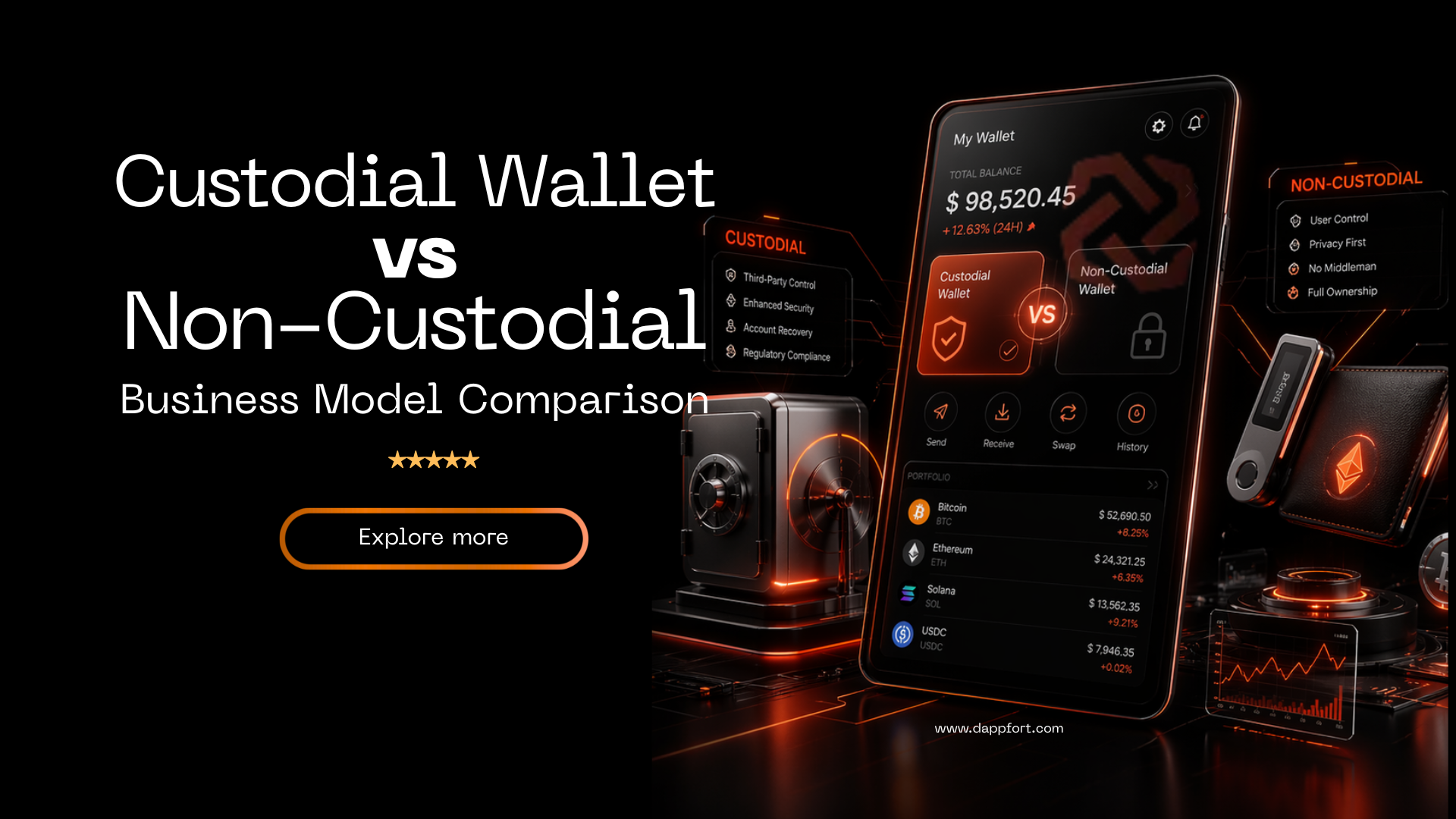
Custodial vs Non Custodial Cryptocurrency Wallet Business Model Comparison for Fintech & Web3 Startups
Quick Answer:
Custodial wallets hold and manage user private keys, generating revenue through transaction fees, subscriptions, custody services, and fiat integrations. Non-custodial wallets give users full control of their funds and monetise through swap fees, staking commissions, premium features, and ecosystem partnerships. Custodial wallet business models are ideal for regulated fintech startups focused on mainstream adoption, while non-custodial wallet business models are better suited for Web3 startups seeking faster launches, user ownership, and open ecosystem. Dappfort cryptocurrency wallet development services helps cryptocurrency startups launch scalable custodial, non-custodial, and hybrid wallet business solutions faster with enterprise-grade security and Web3-ready architecture.
The global digital wallet market is projected to surpass $48 billion by 2030, while Fintech and Web3 startups are racing to capture a wide range of business opportunities in payments, remittances, DeFi, tokenized assets, and digital banking. But despite the market opportunity, many founders overlook the most important early revenue decision:
What wallet business model should you build—custodial or non-custodial?
This business decision goes far beyond wallet architecture.
This single choice influences how your wallet startup onboard users and recover accounts, how assets are stored and secured, what compliance or licensing requirements apply, how quickly you can launch to market, which revenue model makes the most sense, what customer segments you can attract and retain.
The right cryptocurrency wallet business model can unlock multiple revenue streams & steady growth. The wrong wallet business model can create regulatory delays, poor onboarding experiences, higher business operating costs, and slower growth. For fintech startups, Web3 founders, product teams, and investors, the custodial vs non-custodial wallet debate is ultimately a business model decision.
With hundreds of new Fintech and Web3 wallet startups launching annually, speed and security matter more than ever.
In this business decision guide, we break down the real business model differences between custodial and non-custodial wallets, helping startups choose the right path to launch faster, monetise smarter, and scale securely in the evolving digital asset economy.
Choosing between a custodial and non-custodial wallet is one of the strategic business decisions for any fintech or Web3 startup. It shapes your user experience, revenue model, compliance scope, and long-term growth potential.
A custodial wallet is a wallet where the company manages and secures private keys on behalf of users. Whereas, non-custodial wallet gives users full control over their private keys and digital assets.
In Practical Business Terms:
- Custodial wallets optimize for convenience, fast onboarding, and mainstream adoption.
- Non-custodial wallets optimize for ownership, privacy, and open ecosystem access.
For startups looking to build scalable cryptocurrency wallets, Dappfort helps businesses launch custodial, non-custodial, and hybrid wallet solutions tailored for fintech, Web3 business growth.
Why wallet model decision crucial for Fintech & Web3 Startups?
Choosing the wrong cryptocurrency wallet business model early can create costly setbacks in growth, compliance, user adoption, and long-term scalability.
Many startups focus on launch speed or features first, only to discover later that the wallet structure itself limits expansion and monetization.
Common Examples:
- A startup launches a custodial wallet too early and gets overwhelmed by licensing, compliance, and operational costs.
- A fintech company launches a non-custodial wallet, but mainstream users abandon onboarding due to seed phrase complexity and recovery friction.
- A Web3 platform launches a custodial wallet and loses trust with crypto-native users who expect ownership and self-custody.
- A payments startup ignores hybrid wallet models and misses opportunities across both retail and Web3 customer segments.
The Reality for Startups:
The best wallet model depends on three key business factors:
- Who you serve – Retail users, enterprises, traders, gamers, or DeFi communities
- How you monetise – Fees, subscriptions, staking, custody, or embedded finance
- Which markets you enter – Regulated regions, emerging markets, or global crypto ecosystems
For fintech and Web3 startups, this is not just a decision—it is a market entry and growth strategy decision.
What Is a Custodial Wallet?
A custodial wallet is a cryptocurrency wallet where a company or platform manages the user’s private keys and secures funds on their behalf. Users access their wallet through familiar methods such as email login, passwords, OTP verification, or app authentication.
This model is widely used by exchanges, fintech apps, neobanks, and payment platforms because it offers a simple onboarding experience, account recovery options, and customer support.
What Is a Non-Custodial Wallet?
A non-custodial wallet is a cryptocurrency wallet where users fully control their own private keys and digital assets. The platform provides wallet software and blockchain access, but it does not hold customer funds.
Users typically access wallets through seed phrases, passkeys, smart wallets, or social recovery systems. This model is popular in DeFi, NFT platforms, blockchain gaming, DAO tools, and Web3 ecosystems because it gives users full ownership and permissionless access.
Custodial vs Non-Custodial Wallet Comparison:
For many crypto wallet startups, the right business choice depends on customer type, monetization strategy, and target market. Increasingly, startups are adopting hybrid wallet models to combine fintech simplicity with Web3 ownership benefits.
| Factor | Custodial Wallet | Non-Custodial Wallet |
| Asset Control | Company manages user assets | User controls assets |
| User Experience | Very easy and familiar | Moderate learning curve |
| Recovery Support | Strong account recovery options | Limited recovery methods |
| Compliance Burden | High regulatory responsibility | Lower custody-related burden |
| Revenue Predictability | High recurring revenue potential | Medium, usage-based revenue |
| Web3 Compatibility | Moderate | High |
| Launch Speed | Slower due to compliance setup | Faster in many markets |
| Best For | Fintech startups, neobanks, payment apps | Web3 startups, DeFi, gaming, NFT platforms |
What Is a Custodial Cryptocurrency Wallet Business Model?
A custodial cryptocurrency wallet business model is one where the company manages user private keys and secures digital assets on behalf of users. Instead of users controlling their own keys, the platform handles storage, security, and account recovery. This creates a simple and familiar experience similar to online banking or payment apps, making custodial wallets popular among fintech startups, exchanges, and businesses targeting mainstream users.
Best Fit for Custodial Wallet:
Custodial wallet business models are often ideal for fintech startups and enterprises that prioritize convenience, compliance, managed services, and mainstream user adoption. They are commonly the best fit for:
- Fintech apps expanding into crypto services use custodial wallets to offer simple onboarding, account recovery, and seamless crypto access for mainstream users.
- Consumer investing and trading platforms rely on custodial wallets to simplify buying, selling, and managing digital assets within one platform.
- Stablecoin payment products benefit from custodial wallets by enabling fast transactions, secure settlements, and easy user experience for payments. Still more…
These businesses benefit from easier onboarding, account recovery, customer support, and stronger recurring revenue opportunities.
Main Revenue Streams for Custodial Wallet Startups
Custodial wallet companies commonly monetize through:
- Trading spreads generate revenue by charging a margin between buy and sell prices on crypto transactions.
- Deposit and withdrawal fees earn income whenever users move funds into or out of the platform.
- Subscription plans create recurring monthly or annual revenue through premium wallet features and services.
- Custody and asset management fees charge users or institutions for secure storage and managed holdings.
- Interest margin products generate profits by lending deposited assets or offering yield-based financial products.
- Foreign exchange conversion fees earn revenue when users convert between fiat currencies and digital assets.
- Merchant settlement fees charge businesses for processing crypto payments and settling funds efficiently.
Advantages of Custodial Wallet Models
- Easier user onboarding helps startups attract mainstream users with simple signup and login flows.
- Password and account recovery options reduce friction by allowing users to regain access without losing funds permanently.
- Better customer support experience enables businesses to assist users directly with account and transaction issues.
- Strong recurring revenue potential comes from subscriptions, custody fees, and managed financial services.
- Familiar experience for non-crypto users makes custodial wallets feel similar to banking or payment apps, increasing adoption.
Challenges of Custodial Wallet Models
- Higher regulatory and compliance burden requires ongoing KYC, AML, reporting, and legal oversight.
- Security and custody liability means the company is responsible for protecting user funds from hacks or breaches.
- Greater operational complexity comes from managing custody systems, support teams, and financial infrastructure.
- Licensing and legal costs can increase significantly depending on region and business model.
- Insurance and reserve expectations may require additional capital to build user trust and meet institutional standards.
For cryptocurrency wallet startups targeting mass adoption, regulated markets, or financial service integration, custodial wallets can be a powerful growth model when built correctly.
What Is a Non-Custodial Cryptocurrency Wallet Business Model?
A non-custodial cryptocurrency wallet business model gives users full control over their private keys and digital assets. Instead of holding customer funds, the platform provides wallet software, security tools, and access to blockchain ecosystems. This allows users to transact and participate directly in Web3 without relying on a third party to manage assets. Non-custodial wallets are widely preferred for DeFi, NFTs, gaming, and other Web3-native products, with access typically enabled through seed phrases, private keys, passkeys, smart wallets, or social recovery systems.
Best Fit for Non-Custodial Wallet:
This non-custodial wallet is ideal for:
- DeFi startups use non-custodial wallets to give users direct access to staking, lending, and decentralized exchanges.
- NFT marketplaces and ecosystems rely on non-custodial wallets to provide true ownership and seamless asset transfers.
- Blockchain gaming platforms use non-custodial wallets so players can own, trade, and monetize in-game digital assets.
Main Revenue Streams for Non-Custodial Wallet Startups
Non-custodial wallet business commonly monetize through:
- Swap fees generate revenue whenever users exchange one token for another inside the wallet.
- Staking commissions earn income by taking a percentage of rewards from user staking participation.
- Bridge transaction fees monetize cross-chain asset transfers between different blockchains.
- NFT marketplace fees generate revenue from buying, selling, or minting digital collectibles.
- Premium analytics tools create subscription income through advanced portfolio tracking and insights.
- API and developer access earn revenue by charging third parties for wallet infrastructure or integrations.
- Ecosystem partnerships generate income through token listings, promotions, and strategic collaborations.
Advantages of Non-Custodial Wallet Models
- Lower custody and asset liability reduces risk since the platform does not hold or manage user funds.
- Faster launch in many markets is possible due to fewer custody-related regulatory and operational requirements.
- Stronger trust with crypto-native users comes from aligning with ownership, decentralization, and self-custody principles.
- Better interoperability across ecosystems enables seamless interaction with DeFi, NFTs, and multiple blockchain networks.
- Lower long-term operating overhead results from reduced compliance, custody infrastructure, and asset management responsibilities.
Challenges of Non-Custodial Wallet Models
- Higher onboarding friction for new users occurs because users must manage keys or seed phrases during setup.
- Need for user education is essential since users must understand self-custody, security, and wallet management.
- Risk of lost keys or recovery issues can lead to permanent loss of access to funds if credentials are not backed up properly.
- Limited customer support control restricts the platform’s ability to recover accounts or reverse transactions.
- Harder mainstream adoption compared to custodial apps happens because non-crypto users often prefer simpler, recovery-friendly systems.
For Web3 startups prioritizing ownership, decentralization, and ecosystem growth, non-custodial wallets often provide the fastest path to market and strongest product-market fit.
Which Wallet Model Is Best for Fintech Startups?
For most fintech startups, the best wallet model depends on customer expectations, revenue goals, and regulatory strategy. If your business targets mainstream users who value convenience, trust, and familiar financial experiences, a custodial wallet model is often the strongest fit.
Custodial wallets allow startups to offer smoother onboarding, account recovery, customer support, and integrated banking-style services—features that are essential for mass-market fintech adoption.
Choose Custodial if Your Priorities Are:
- Mainstream users with low crypto experience
- Card, bank, or fiat payment integrations
- Subscription-based recurring revenue
- Treasury and managed asset services
- Customer support-heavy business models
- Institutional trust and compliance readiness
Why It Works for Fintech?
Custodial wallets create an experience similar to banking apps, making them easier for everyday users and businesses to adopt. They also open monetization opportunities through fees, premium plans, custody services, and financial products.
Common Fintech Use Cases
- Payroll apps using stablecoins enable companies to pay employees globally with faster and lower-cost transactions.
- Consumer investing platforms allow users to buy, hold, and manage digital assets within a regulated fintech environment.
- SME treasury management tools help small and medium businesses manage cash flow, liquidity, and crypto holdings efficiently.
- Cross-border payment platforms facilitate faster and cheaper international transfers compared to traditional banking systems.
- Neo-banking apps with crypto features integrate digital assets into everyday banking services like savings, transfers, and spending.
- Merchant settlement solutions enable businesses to accept crypto payments and receive instant or near-instant settlements.
If your fintech startup is focused on trust, simplicity, compliance, and recurring revenue, custodial wallets are often the most practical and profitable path. Dappfort helps fintech startups build secure custodial wallet platforms with banking integrations, compliance-ready infrastructure, and scalable revenue-focused features.
Which Wallet Model Is Best for Web3 Startups?
For most Web3 startups, a non-custodial wallet model is often the best fit because it aligns with the core values of decentralization, ownership, and permissionless access. Crypto-native users typically expect full control over their assets, seamless ecosystem connectivity, and the ability to interact directly with blockchain applications.
Non-custodial wallets allow startups to scale globally faster while reducing custody-related operational burden.
Choose Non-Custodial if Your Priorities Are:
- DeFi integrations and protocol access
- NFT ownership and asset portability
- Token ecosystems and community incentives
- Community trust through self-custody
- Fast global user growth
- Permissionless access across markets
Why Does It Works for Web3?
Non-custodial wallets are designed for open blockchain ecosystems. They connect users directly to decentralized apps, staking platforms, DAOs, games, and multi-chain networks without relying on centralized custody.
This creates stronger trust signals with crypto-native communities and supports faster product adoption.
Common Web3 Use Cases
- DeFi protocols and yield platforms enable users to lend, borrow, trade, and earn yield directly on blockchain networks.
- NFT marketplaces and creator ecosystems allow artists and creators to mint, trade, and monetize digital collectibles.
- Gaming wallets and in-game asset platforms give players true ownership of in-game items and the ability to trade them freely.
- DAO governance infrastructure tools support decentralized decision-making through token-based voting systems.
- Cross-chain wallet products enable users to manage and transfer assets across multiple blockchain networks seamlessly.
- Token launch and community platforms help projects distribute tokens, build communities, and manage early ecosystem growth.
Takeaway:
If your Web3 startup depends on ownership, ecosystem participation, and rapid global expansion, non-custodial wallets are usually the strongest strategic choice. Dappfort helps Web3 founders build secure non-custodial wallet platforms with multi-chain support, smart wallet features, DeFi integrations, and scalable user experiences.
Why Hybrid Wallet Startup Models Are Winning Another Side?
Many of the fastest-growing fintech and Web3 startups no longer choose only custodial or non-custodial wallets. Instead, they adopt hybrid wallet models that combine the convenience of traditional finance with the ownership benefits of Web3.
This approach helps startups attract mainstream users without losing crypto-native audiences.
Hybrid wallets solve one of the biggest growth challenges in crypto:
- Beginners want simplicity — fast signup, recovery options, and easy transactions
- Power users want control — ownership, DeFi access, and self-custody freedom
By serving both user types, startups can reduce onboarding friction while increasing long-term retention.
Hybrid models often offer the best balance of growth, monetization, and user experience—making them a leading choice for modern wallet startups. Dappfort helps businesses build secure hybrid wallet platforms with custodial onboarding, self-custody upgrades, fiat integrations, and scalable Web3 infrastructure designed for long-term growth.
Final Thoughts:
Choosing between a custodial and non-custodial cryptocurrency wallet is not a simple decision—it is a business strategy decision that shapes revenue, compliance, user growth, and long-term scalability.
- Custodial wallets are ideal for fintech startups that prioritize mainstream onboarding, managed services, recurring revenue, and regulatory trust.
- Non-custodial wallets are better suited for Web3 startups focused on ownership, DeFi access, token ecosystems, and global community growth.
For many modern startups, hybrid wallet models offer the strongest path forward by combining easy onboarding with optional self-custody, allowing businesses to serve both beginners and crypto-native users. The most successful startups will not choose the most popular wallet model—they will choose the one that best matches their users, market strategy, and monetisation goals.
If you are planning to launch a secure and scalable wallet product, Dappfort cryptocurrency Wallet Development company helps founders build custodial, non-custodial, and hybrid wallet solutions designed for faster launches, stronger revenue potential, and long-term growth.
GET IN TOUCH
Need help building the right wallet model?
If you’re trying to decide the right wallet model, start by anchoring the decision to 3 things: your users, your revenue plan, and your regulatory comfort zone.The key is not choosing what looks best in theory, but what fits your first stage of growth. Dappfort team gives the best consultation for choosing the right wallet model.
FAQs
What is the main difference between custodial and non custodial wallets?
Custodial wallets are managed by a company that stores private keys for users, while non custodial wallets give users full control of their private keys and funds.
Which wallet model is better for fintech startups?
Custodial wallets are usually better for fintech startups because they provide easier onboarding, built-in compliance systems, and more predictable revenue models.
Which wallet model is better for Web3 startups?
Non custodial wallets are better for Web3 startups because they support decentralization, DeFi access, NFTs, and full user ownership of assets.
Can a startup use both custodial and non custodial wallets?
Yes. Many modern startups use hybrid wallet models that combine custodial onboarding with optional self-custody features for advanced users.
Which wallet model is safer?
Both are safe in different ways. Custodial wallets rely on company security systems, while non custodial wallets rely on user-controlled private keys.


