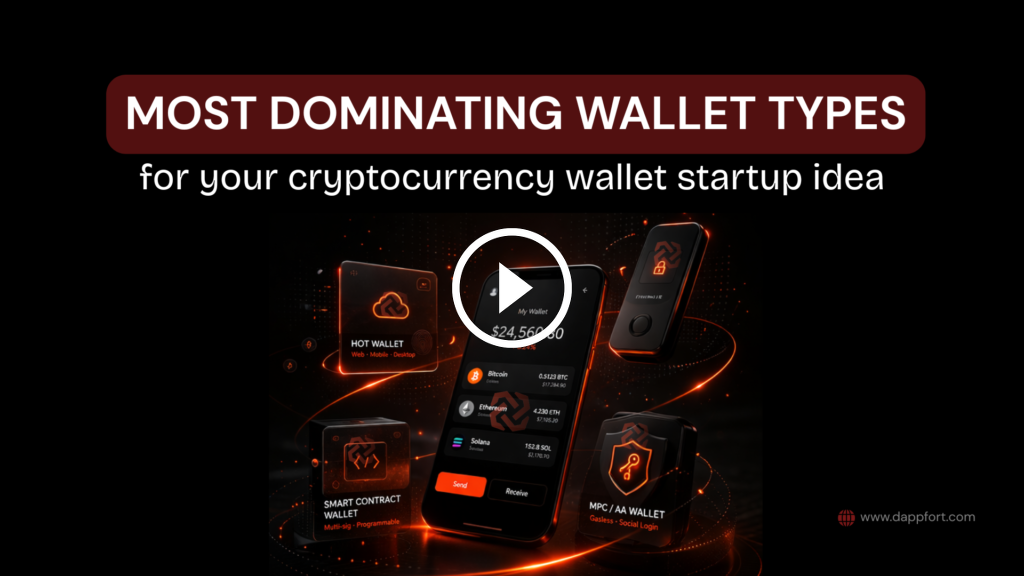
Quick Read:In 2026, 10 crypto wallet types— like MPC, smart-contract, hardware, and hybrid wallet models—are reshaping Web3. Startups that understand these fast-rising wallet technologies can boost security, simplify onboarding, and stay ahead of competitors. This startup guide provides a clear breakdown of the 10 most important cryptocurrency wallet types in 2026, so you can choose the right infrastructure for your crypto wallet startup. Published by Dappfort cryptocurrency wallet development service provider
Introduction: Why Crypto Wallet Types Matter More Than Ever in 2026?
The global crypto landscape is evolving at lightning speed. With more than 650 million people using crypto in 2026—and the U.S. emerging as one of the fastest-growing markets—wallet adoption is accelerating faster than exchanges, blockchains, or dApps. As more Americans shift toward non-custodial and hybrid wallets, security, control, and smarter cryptocurrency storage options are becoming top priorities.
For new crypto startups, the challenge isn’t simply launching a wallet—it’s choosing the right type amid rising security risks, shifting user behavior, and increasing regulatory pressure. Recent wallet-hacking incidents make it clear: the stakes have never been higher.
Selecting the wrong cryptocurrency wallet architecture can stop the startup success, frustrate users, and limit business growth. But choosing the right one can boost user adoption, improve security, and unlock new revenue opportunities.
This guide breaks down the 10 wallet types dominating the current scenario and reveals what startups need to know to build secure, compliant, and competitive products in the global market.
What Are Cryptocurrency Wallet Types?
Cryptocurrency wallet types are categories of digital wallets that store your private keys and allow you to send, receive, and manage crypto assets.
Wallets are classified based on how they connect to the internet, who controls the private keys, and what features or functions they support. Understanding these wallet types helps users choose the safest and most convenient way to store crypto in 2026 and beyond.
Crypto Wallets vs. Crypto Accounts (Important to Know)
Understanding this difference helps to choose safer cryptocurrency storage options and avoid common hacking risks.
| Crypto Wallets | Crypto Accounts |
| You control your private keys and store assets directly on the blockchain. | Exchanges or apps control the keys and hold assets on your behalf—similar to a bank account. |
Wallets are categorized by three main factors:
1. Connectivity (Hot vs. Cold Wallets)
- Hot Wallets: Internet-connected (mobile apps, browser extensions). Easy to use, ideal for daily transactions.
- Cold Wallets: Offline storage (hardware devices, paper wallets). Highest security for long-term holding.
2. Control (Custodial vs. Non-Custodial)
- Custodial Wallets: A company controls your private keys. Best for beginners and easy recovery.
- Non-Custodial Wallets: You control your private keys. More secure and decentralized but requires responsibility.
3. Functionality (Depends on How You Use the Wallet)
- Mobile Wallets – user-friendly apps for everyday use
- Hardware Wallets – offline physical devices
- Smart-Contract Wallets – programmable wallets with social recovery
- Browser Extension Wallets – browser-based for Web3 and dApps
- MPC Wallets – advanced multi-party security
- Multi-Sig Wallets – shared access for teams and DAOs
- Custodial Platforms – exchange or app-managed storage
The 10 Most In-Demand Cryptocurrency Wallet Types in 2026 for Startup Idea:
- Mobile Wallets
- Web Wallets (Browser Wallets)
- Desktop Wallets
- Hardware Wallets (Cold Storage Devices)
- Paper Wallets
- Smart Contract Wallets
- Multi-Signature Wallets (Enterprise + DAO Focus)
- HD Wallets (Hierarchical Deterministic)
- Exchange Wallets (Custodial)
- Brain Wallets
4 Main Types of Cryptocurrency Wallets
Understanding the core types of cryptocurrency wallets helps users, businesses, and startups choose the right security model for their needs. These four categories—hot, cold, custodial, and non-custodial—form the foundation of all modern wallet types used across Web3, DeFi, payments, and long-term crypto storage.
Most users don’t fully understand the differences between wallet types, especially when it comes to security risks, key ownership, and regulatory protections. This confusion leads to mistakes such as keeping large holdings in hot wallets or relying entirely on custodial platforms vulnerable to downtime or breaches.
Hot Wallets
Hot wallets are internet-connected cryptocurrency wallets used for fast, convenient access to digital assets. They include mobile apps, desktop apps, and browser extension wallets. In the U.S., they are extremely common in exchanges and Web3 apps.
Use Cases:
- Daily crypto payments
- DeFi, NFTs, staking, and Web3 apps
- Active trading on crypto exchanges
- Managing multi-chain portfolios
| Pros | Cons |
| Extremely convenient and fast | Higher risk of hacks, malware, and phishing |
| Ideal for beginners, Great for frequent transactions | Requires strong personal security habits |
| Compatible with most popular dApps and platforms | Not ideal for long-term or high-value storage |
Cold Wallets
Cold wallets store private keys offline, making them the safest way to hold large amounts of cryptocurrency. Long-term crypto investors often prefer hardware wallets for protecting large portfolios. Common types include hardware wallets and paper wallets.
Use Cases:
- Long-term storage (“HODLing”)
- High-value crypto portfolios
- Treasury or institutional security
- Maximum protection
| Pros | Cons |
| Strongest defense against online attacks | Less convenient for frequent transactions |
| No exposure to malware or phishing | Hardware devices cost money, Losing the device or backup phrase can mean permanent loss |
| Ideal for safeguarding long-term holdings | Slower to use with DeFi or Web3 apps |
Custodial Wallets
Custodial wallets rely on a third-party service—like a regulated exchange or crypto trading platform—to store and manage your private keys for you. Platforms like Coinbase, Kraken, and Gemini dominate this category.
Why Many Users Prefer Custodial Wallets:
- Regulated companies feel safer
- Easy onboarding and recovery options
- Integrated trading, staking, and payments
- No need to manage seed phrases
| Benefits | Risks |
| Easiest user experience | You don’t fully control your crypto |
| Password/account recovery | Platform hacks or outages can affect access |
| All-in-one platform features | KYC/AML requirements and withdrawal limits may apply |
Non-Custodial Wallets (Web3-Native)
Non-custodial wallets give users full control of their private keys. U.S. Web3 users rely heavily on apps like MetaMask, Phantom, Coinbase Wallet, and others for true digital ownership.
Why They’re Popular in Web3:
- Keys remain with the user, not a company
- Perfect for DeFi, NFTs, and decentralized apps
- No banking or platform restrictions
- Enhanced privacy and independence
| Benefits | Risks |
| Full ownership of assets | Users must handle seed phrase recovery |
| No third-party risk | Mistakes can lead to permanent loss |
| Essential for Web3 interaction | Requires personal security discipline |
10 Most Dominating Cryptocurrency Wallet Types for Startups Ideas in 2026
Many startups struggle to identify which wallet types truly matter in 2026 and beyond—especially as U.S. regulations, security standards, and new technologies like MPC, AI, and account abstraction rapidly change the landscape. Below is a streamlined, startup-focused list of the 10 most important cryptocurrency wallet types to consider, based on real-world adoption trends, enterprise usage, and the needs of modern Web3 products.
1. Mobile Wallets (Most Popular)
Mobile wallets are app-based crypto wallets designed for quick access, payments, and everyday use on smartphones.
How It Works:
They store private keys on the device and connect to the internet for transactions, swaps, and dApp interactions. Example: Coinbase Wallet, MetaMask Mobile
| Pros | Cons |
| Extremely convenient | Vulnerable to malware if device is compromised |
| Ideal UX for beginners | Not ideal for high-value storage |
| Supports multi-chain assets | |
| Fast payments & transfers |
Who Should Use It:
Retail users, traders, NFT collectors, beginners, on-the-go crypto users.
Why Should Startups Build it?
Mobile wallets dominate global adoption and drive the largest user acquisition funnel of all wallet types.
2. Web Wallets (Browser-Based Wallets)
Web wallets run directly in a browser—no installation required. Fastest growing wallet type in Web3 sector.
How It Works:
Private keys are stored in the browser or on the provider’s servers, depending on design, and accessed via login. Example: MetaMask, Phantom
| Pros | Cons |
| Lightweight and accessible from any device | Higher risk if browser is insecure |
| Easy onboarding | Limited offline protection |
| Ideal for fast dApp access |
Who Should Use It:
dApp users, casual traders, users accessing crypto from shared devices.
Why Startups Should Build It?
They offer frictionless onboarding and expand reach, especially in developing markets with low-end devices.
3. Desktop Wallets
Desktop wallets are software applications installed on a computer for storing and managing crypto.
How It Works:
Private keys are stored locally and are only exposed when the app connects online to sign transactions. Example: Electrum
| Pros | Cons |
| Privacy focused than web wallets | Less convenient than mobile |
| Advanced settings and control | Requires technical familiarity |
| Good security when device is protected |
Who Should Use It?
Developers, advanced users, privacy-focused individuals.
Why Startups Should Build It?
Desktop wallets attract power users who demand advanced tools—ideal for niche positioning.
4. Hardware Wallets (Cold Storage Devices)
Hardware wallets are physical devices that store private keys offline for maximum security.
How It Works:
Transactions are signed inside the device without exposing private keys to the internet. Example: Ledger, Trezor
| Pros | Cons |
| Extreme crypto security | Costs money |
| Immune to online hacks | Less convenient for daily use |
| Ideal for long-term storage |
Who Should Use It?
Long-term holders, high-net-worth users, institutions.
Why Startups Should Build It?
Integration with hardware wallets boosts trust and attracts premium, security-conscious customers.
5. Paper Wallets
A paper wallet stores private keys or QR codes printed on paper.
How It Works:
Keys are generated offline and printed. The paper itself becomes the storage medium.
| Pros | Cons |
| Completely offline | Easy to damage or lose |
| No hardware cost | Not user-friendly |
| Not ideal for modern multi-chain use |
Who Should Use It?
Highly niche users, archivists, or those needing long-term cold storage without devices.
Why Startups Should Build It?
Not recommended as a primary product, but can be included as a backup/recovery option in a broader wallet ecosystem.
6. Smart Contract Wallets (Web3-Native)
Smart-contract wallets use blockchain-based code instead of traditional private keys.
How It Works:
They support features like account abstraction, social recovery, role-based permissions, and gasless transactions.
| Pros | Cons |
| Seed phrase–free, Highly customizable | Dependent on blockchain uptime |
| Ideal for onboarding newcomers | Smart contract vulnerabilities possible |
| Best UX for Web3 |
Who Should Use It?
New crypto users, mainstream Web3 users, dApp explorers, DAOs, and businesses.
Why Startups Should Build It?
Fastest-growing wallet category due to mass adoption potential and account abstraction standards (ERC-4337+).
7. Multi-Signature Wallets (Enterprise Grade)
Multi-sig wallets require multiple approvals to sign transactions.
How It Works:
A transaction only executes when a predefined number of key holders sign (e.g., 2-of-3 signatures).
| Pros | Cons |
| Extremely secure | Slower for daily use |
| Ideal for teams and treasuries | Not ideal for simple personal wallets |
| Eliminates single point of failure |
Who Should Use It?
DAOs, companies, crypto funds, shared accounts, treasuries.
Why Startups Should Build It?
Multi-sig wallets attract enterprise clients and unlock B2B revenue streams.
8. HD Wallets (Hierarchical Deterministic Wallets)
HD wallets generate a series of private/public key pairs from one seed phrase.
How It Works:
A single recovery phrase (12–24 words) generates all future wallet addresses through a deterministic algorithm.
| Pros | Cons |
| Highly secure | Users must protect recovery phrase |
| Easy backup with one seed phrase | Loss of phrase = loss of assets |
| Industry standard for modern wallets |
Who Should Use It:
Everyone—retail users, traders, businesses, long-term holders.
Why Startups Should Build It:
It’s the global standard; nearly all modern wallets must be HD-compatible.
9. Exchange Wallets (Built-In Custodial Wallets)
Wallets provided by centralized exchanges or trading platforms.
How It Works:
The platform controls the private keys and manages all security and custody operations. Example: Coinbase, Binance.US
| Pros | Cons |
| Easiest onboarding | Users must protect recovery phrase |
| Integrated trading, swaps, and staking | Loss of phrase = loss of assets |
| No seed phrase management | Exchange hacks or insolvency risks |
| Subject to strict KYC/AML |
Who Should Use It:
Beginners, casual investors, high-frequency traders.
Why Startups Should Build It:
Exchange-style custodial wallets drive revenue through trading fees and financial services.
10. Brain Wallets
A brain wallet uses a user-created passphrase to generate the private key.
How It Works:
A cryptographic algorithm derives wallet keys from a human-memorized passphrase instead of stored data.
| Pros | Cons |
| No physical or digital storage | Extremely insecure if phrase is guessable |
| Can be used anywhere in the world | Loss of phrase = loss of assets |
| Not recommended for modern use |
Who Should Use It:
Only experts who understand the risks—generally discouraged.
Why Startups Should Build It:
They shouldn’t be a core product—but can educate users on why safer alternatives exist.
Comparison: Top 10 Cryptocurrency Wallet Types
Click here to get comparison table adds a Startup Fit to show which wallet types work best for different startup goals, industries, and user groups.
| Wallet Type | Ownership | Security Level | Ease of Use | Best For | Startup Fit (Why Startups Choose It) |
| Mobile Wallets | User-controlled | Medium | Very Easy | Daily use, DeFi, NFTs | Perfect for consumer-focused apps needing fast onboarding and high retention. |
| Web Wallets (Browser Wallets) | User-controlled | Medium | Easy | dApps, Web3 access | Best for Web3, gaming, and NFT platforms needing instant browser-based access. |
| Desktop Wallets | User-controlled | Medium–High | Moderate | Advanced users | Ideal for startups building power-user tools like validators, miners, or dev tooling. |
| Hardware Wallets | User-controlled | Very High | Low | Long-term storage | Great for security-focused products; ideal add-on for institutions or premium users. |
| Paper Wallets | User-controlled | High (offline) | Low | Cold storage | Rarely used today; only relevant for cold-storage or archival-focused solutions. |
| Smart Contract Wallets | User-controlled | High | Very Easy | Web3 apps, onboarding | Best for mainstream onboarding, social recovery, account abstraction, and gasless UX. |
| Multi-Signature Wallets | Shared control | High | Moderate | Enterprises, DAOs | Ideal for treasury management, DAO operations, and enterprise custody startups. |
| HD Wallets | User-controlled | Medium–High | Moderate | Multi-address users | Strong fit for startups offering multi-chain support, privacy tooling, or wallets at scale. |
| Exchange Wallets (Custodial) | Platform-controlled | Medium | Very Easy | Trading & beginners | Best for startups building exchanges, fiat ramps, or products requiring easy recovery + compliance. |
| Brain Wallets | User-controlled | Low | Hard | Niche offline use | Not recommended for startups; extremely insecure and difficult to scale. |
How Startups Should Choose Which Wallet Type to Build?
Choosing the right wallet type is one of the most critical decisions for a crypto startup. The wallet model determines your target audience, revenue streams, compliance burden, security requirements, and long-term scalability. Instead of building “everything,” startups should choose a wallet type that aligns with their business strategy and product vision.
Below is a structured framework to help founders make the right decision.
1. Target Audience: Who Are You Building For?
Different users demand different wallet experiences:
| Audience Segment | Best Wallet Types |
| Beginners | Custodial, Mobile, Exchange Wallets |
| Web3 Users | Smart Contract, Browser Extension Wallets |
| Traders | Mobile, Exchange, Desktop |
| Institutions | MPC, Multi-Sig, Hardware Wallet Integrations |
| Long-Term Holders | Hardware, Cold Storage |
| Merchants | Payment Wallets, Custodial Business Wallets |
Understanding your core user persona reduces product bloat and speeds up time-to-market.
2. Compliance Requirements
Wallet types come with dramatically different regulatory burdens:
- Low compliance: Non-custodial wallets (mobile, browser, smart-contract)
- Moderate compliance: MPC wallets, multi-sig wallets (for B2B/KYC-lite environments)
- High compliance: Custodial wallets, exchange wallets, merchant wallets
If your startup wants to avoid heavy regulation early, non-custodial models offer faster, safer scalability.
3. Revenue Model Alignment
Your wallet type should match your intended revenue source:
| Revenue Model | Ideal Wallet Types |
| Transaction fees | Mobile, Browser Extension, DeFi wallets |
| Subscriptions | Smart-contract wallets, MPC enterprise wallets |
| WaaS (Wallet-as-a-Service) | MPC, multi-sig, smart-contract wallets |
| Trading spreads | Exchange wallets, custodial apps |
| Payment processing | Merchant wallets |
| Premium security | Hardware integrations, MPC |
A strong business model fit is often more important than feature quantity.
4. Security & Engineering Resources
Some wallet types require heavy infrastructure investments:
| Security Requirement | Suitable Wallet Types |
| Low–Moderate | Mobile, Web, Desktop |
| High | Smart Contract wallets, multi-chain wallets |
| Very High | MPC, Multi-Sig, Hardware integrations |
Startups with limited engineering budgets should avoid MPC-heavy or deep custodian infrastructure early on.
5. Multi-Chain Compatibility
If you plan to support multiple chains:
- Easiest to scale: Mobile, browser, smart-contract wallets
- Harder to scale: Hardware, desktop, multi-sig wallets
- Highest cost: MPC and enterprise-grade solutions
Multi-chain capability is a must in 2026 due to the rise of L2s, modular blockchains, and appchains.
6. Web3 User Expectations
Web3 users increasingly expect:
- Gasless transactions
- Social recovery
- Multi-chain compatibility
- NFT visibility
- dApp auto-connection
- Transaction simulation and risk scoring
Smart-contract wallets and browser extension wallets fit these expectations best.
By understanding these 10 wallet types, startups can choose the best model for their users, reduce compliance costs, strengthen security, and build a product that scales with Web3’s evolution. Review each of the 10 wallet types and identify which one best fits your target audience—then prototype your top choice to validate product-market fit quickly.
Steps to Build a Wallet for Your Startup Idea:
Choosing the right cryptocurrency wallet type is one of the most defining strategic decisions a crypto startup will make. With user expectations evolving, multi-chain ecosystems expanding, and global regulations tightening, the wallet model you choose will directly determine your target market, compliance responsibilities, security investment, and long-term revenue potential.
Many first-time founders make the mistake of trying to support every wallet feature at once—only to burn through resources without achieving product–market fit. Instead, startups must evaluate wallet types based on who they serve, how they plan to generate revenue, and what security and compliance environment they can realistically support.
Step 1: Setting your Target Audience
Who is your primary user?
- Beginners → Mobile Wallet / Custodial Wallet
- Web3 dApp users → Browser Extension / Smart-Contract Wallet
- Institutions → MPC Wallet / Multi-Sig Wallet
- Long-term holders → Hardware Integration Wallet
- Merchants → Payment Wallet (Custodial or Hybrid)
Step 2 : Consolidating Compliance Requirements
What is your compliance tolerance?
- Low: Non-custodial mobile, browser, or smart-contract
- Medium: MPC, multi-sig
- High: Exchange-style custodial wallet
Step 3 : Deciding the Revenue Streams
What revenue model fits your business?
- Transaction volume → Mobile / Browser Extension
- Subscriptions → Smart-Contract / MPC
- Trading fees → Exchange wallets
- Enterprise SaaS → Multi-sig / MPC
Step 4 : Security requirement assessment
What level of security does your audience expect?
- Basic: Mobile, Web
- Advanced: Smart-contract, multi-chain wallets
- Institutional: Multi-Sig, MPC, Hardware integrations
Step 5 : Supporting with Multi-chain Support
Do you need multi-chain support?
- Yes: Mobile, Browser Extension, Smart-Contract
- No: Hardware, Desktop, Basic Custodial
How to Choose the Wallet Type for your Startups?
- If you want mass adoption → build a mobile wallet
- If you want Web3 power users → build a browser extension or smart-contract wallet
- If you want institution-grade features → build MPC or multi-sig
- If you want trading revenue → build a custodial exchange wallet
- If you want business payments → build merchant wallets
Business Advantages of Supporting Multiple Wallet Types
Supporting multiple wallet types isn’t just a technical upgrade—it’s a strategic business advantage that expands your market reach, strengthens your product, and accelerates long-term growth. For crypto startups, offering diverse wallet options directly impacts acquisition, engagement, and revenue performance across the full user lifecycle.
1. Wider User Acquisition
Different users prefer different wallet formats—mobile apps for beginners, browser extensions for Web3 explorers, hardware integrations for serious holders, and multi-sig for businesses.
When your product supports multiple wallet types, you instantly:
- Tap into broader demographics
- Unlock global adoption across devices
- Attract both retail and institutional users
This dramatically increases your total addressable market (TAM) from day one.
2. Better User Retention
Users stay longer when they can switch wallets as their needs evolve.
Example: A beginner might start with a custodial wallet and later transition to a smart-contract wallet or hardware device.
Supporting multiple types ensures users don’t outgrow your ecosystem, reducing churn and extending their journey within your platform.
3. Cross-Chain Usability
As new L1s, L2 rollups, and appchains explode in 2026–2027, users demand wallets that work everywhere.
Multi-wallet setups allow:
- Seamless access across chains
- Faster onboarding to new ecosystems
- Better compatibility with dApps, NFTs, and DeFi protocols
This positions your product as a future-proof multi-chain access layer.
4. Increased Transaction Volume
More wallet types = more activity funnels.
You enable users to transact:
- On mobile
- On desktop
- Through browser extensions
- Via smart-contract wallets
- With MPC or multi-sig for teams
- Across multiple chains
Higher accessibility reliably boosts:
- Swaps
- Transfers
- Staking
- Cross-chain bridging
- dApp usage
Greater transaction flow translates directly into higher revenue.
5. Higher Lifetime Value (LTV)
Supporting multiple wallet types increases LTV by:
- Expanding the use cases each user can adopt
- Introducing premium features (MPC, AA wallets, hardware integrations)
- Improving retention and reducing churn
- Enabling cross-selling inside the wallet ecosystem
Users gain more reasons to keep using your product—meaning more revenue per user over time.
6. Reduced Support Issues
Many support tickets arise when users try to move between incompatible wallet systems.
When your product supports multiple wallet types directly, users can:
- Recover accounts more easily
- Switch wallets without friction
- Avoid key-loss or migration errors
- Reduce confusion around chain support
This leads to lower support costs, fewer escalations, and higher user satisfaction.
Real-World Use Cases & Startup Examples
Understanding how leading companies choose their wallet types helps startups make smarter product decisions.
Below are real-world patterns showing why different industries select specific wallet architectures—and what this means for new wallet builders entering the market.
1. DeFi Platforms Choosing Non-Custodial Wallets
DeFi platforms rely on user-owned private keys to enable permissionless access, decentralized governance, and trustless transactions.
Real-World Examples:
- MetaMask → The default non-custodial wallet for DeFi users across thousands of dApps
- Rabby Wallet → Gaining traction for safer signing flows and multi-chain features
- Trust Wallet → Used widely by retail DeFi traders on mobile
- Coinbase Wallet (non-custodial mode) → entry point for DeFi
Use Case Alignment:
- Liquidity provision
- Lending & borrowing
- Yield farming
- Decentralized trading
- NFT minting
Takeaway for Startups:
If you’re building for DeFi users, non-custodial wallets are the industry standard and provide the lowest compliance overhead.
2. Exchanges Using Custodial Wallets
Centralized exchanges need full control over private keys to power integrated trading, instant transfers, and consolidated asset management.
Real-World Examples:
- Coinbase → Custodial wallets with built-in trading, staking, and earn features
- Binance → High-performance custodial infrastructure for global markets
- Kraken → Secure custodial vault + seamless exchange integration
- Coinbase Wallet (Custodial Mode) → Optional for users who prefer managed storage
Use Case Alignment:
- Retail trading
- Fiat on/off-ramping (ACH, debit cards)
- Institutional trading desks
- Staking and reward programs
Takeaway for Startups:
Custodial wallets unlock profitable business models (trading fees, spreads, staking rewards), but require stronger compliance, KYC, AML, and regulatory controls.
3. Web3 Apps Using Smart Contract Wallets
Smart contract wallets offer account abstraction, gasless UX, programmable permissions, and seed phrase–free onboarding, making them ideal for mainstream Web3 users.
Real-World Examples:
- Argent → Popular for social recovery and beginner-friendly onboarding
- Safe (formerly Gnosis Safe) → The go-to infrastructure for smart contract accounts
- Zerion Wallet → Smart-contract powered multi-chain wallet for dApps & NFTs
- Coinbase Smart Wallet (2024–2026 rollout) → account abstraction onboarding
Use Case Alignment:
- dApp onboarding
- Social/Web3 gaming
- On-chain identity
- Gasless transactions
- Multi-chain interactions
Takeaway for Startups:
Smart contract wallets are the fastest-growing wallet category, driven by account abstraction standards like ERC-4337.
4. Enterprises Using Multi-Sig/MPC Wallets
Multi-sig wallets provide shared approval, auditability, and governance control—critical for companies managing large treasuries or shared assets. Enterprises require shared approval, governance controls, and strong auditability—making multi-sig and MPC the preferred models.
Real-World Examples:
- Fireblocks → Leading MPC + policy-based enterprise wallet
- BitGo → Institutional custody with multi-sig
- Safe (Gnosis Safe) → DAO treasury standard
- Ledger Enterprise Solutions → Hybrid MPC + hardware
Use Case Alignment:
- Corporate treasury management
- DAO operations
- Crypto fund administration
- Multi-party governance
- Enterprise-level payments
Takeaway for Startups:
Multi-sig and MPC wallets give access to high-value B2B clients, longer contracts, and higher LTV—but require deeper security investment.
Summary:
- DeFi Platforms → Non-Custodial Wallets (freedom + control)
- Crypto Exchanges → Custodial Wallets (regulation + trading)
- Web3 Apps → Smart Contract Wallets (UX + programmability)
- Enterprises → Multi-Sig/MPC Wallets (security + governance)
Startups that align wallet architecture with industry-specific needs gain faster adoption, clearer product–market fit, and stronger revenue potential.
Future of Cryptocurrency Wallet Types (2026–2030 Trends)
The crypto wallet landscape is evolving faster than ever. As security expectations rise, multi-chain ecosystems mature, and mainstream users enter Web3, the next generation of wallets will look radically different from today’s mobile, hardware, and browser-based options. The 2026–2030 era will be defined by smarter, safer, more seamless wallet experiences powered by cryptography, AI, and decentralized identity.
Below are the major wallet trends every startup should prepare for.
1. MPC Wallets
Multi-Party Computation wallets are quickly replacing legacy custodial and multi-sig systems. By splitting private keys across multiple devices or entities, MPC wallets eliminate single points of failure and enable enterprise-level redundancy.
Why it matters:
- Stronger security without sacrificing usability
- Essential for banks, fintechs, trading desks
- Enables crypto custody integrations at scale
Startup Insight:
MPC will become the baseline for Wallet-as-a-Service (WaaS) offerings and enterprise custody solutions by 2030.
2. Social Recovery Wallets
Most users lose their seed phrases; social recovery solves this by letting trusted contacts or devices restore wallets. Driven by Account Abstraction (ERC-4337+) and smart-contract wallets.
Key benefits:
- No seed phrase needed
- Easy onboarding for non-technical users
- Supports multi-device and family recovery methods
Startup Insight:
Wallets with seedless onboarding will be the default user experience for mass Web3 adoption.
3. AI-Powered Smart Wallets
AI will become a built-in assistant for crypto safety, automation, and financial insights.
Capabilities emerging by 2030:
- Risk scoring for transactions
- Auto-detection of scams
- Gas fee optimization
- Portfolio rebalancing
- Personalized investment predictions
Startup Insight:
AI-powered wallets will dominate consumer fintech–Web3 hybrids and attract the next billion users.
4. Zero-Knowledge (ZK) Privacy Wallets
Users want privacy without sacrificing compliance. ZK proofs allow users to prove ownership or eligibility without revealing any personal information.
What ZK wallets unlock:
- Identity verification without doxxing
- Private transactions
- Cross-chain ZK bridges
- Compliance-friendly privacy
Startup Insight:
ZK wallets will be essential for Web3 identity, gaming, enterprise compliance, and private DeFi transactions.
5. Account Abstraction Wallets
Account abstraction removes the need for traditional keypairs and replaces them with programmable smart accounts.
Key features:
- Gasless transactions
- Session keys for gaming & dApps
- Auto-pay transactions
- Role-based permissions
- Social recovery
- Multi-chain native support
Startup Insight:
AA wallets will be standard in all consumer-facing crypto products, similar to login-with-email in Web2.
6. Wallet-as-a-Service (WaaS) for Startups Becoming a Dominant Model
Startups no longer need to build wallet infrastructure from scratch. WaaS providers offer plug-and-play components like MPC custody, smart-contract accounts, and cross-chain support.
Benefits for new startups:
- 90% faster time-to-market
- Reduced security liability
- Lower compliance overhead
- Built-in multi-chain support
- Pre-audited infrastructure
Startup Insight:
WaaS platforms become the backbone of the next Web3 ecosystem—similar to how Stripe, AWS, and Firebase powered Web2 growth.
How USA Influence on Wallet Startup Trends?
- U.S. regulations are pushing companies toward MPC, compliant privacy tech, and audited WaaS providers.
- Biometric authentication is becoming a major wallet requirement due to mainstream U.S. user behavior.
- AI-powered safety is quickly becoming mandatory due to rising fraud and phishing attacks.
- Demand for seedless onboarding continues to accelerate social recovery and account abstraction.
Startups that embrace these trends early will gain a strong competitive edge and build wallets ready for the next wave of global adoption.
Must-Choose Wallet Types for Startups in 2026–2027
As the wallet ecosystem rapidly expands, choosing the right starting point determines whether a startup gains early traction or spreads its resources too thin. The most successful teams focus on wallet types that deliver immediate value, align with user expectations, and support long-term scalability.
These categories dominate product adoption and ecosystem demand:
- Smart-contract wallets → best onboarding, seedless UX, account abstraction
- Mobile non-custodial wallets → largest global reach and fastest-growing user base
- Browser extension wallets → essential for Web3, DeFi, and NFT-heavy audiences
- MPC wallets → institutional security standard for enterprise and high-value accounts
These four wallet types cover nearly every major crypto segment.
Recommended starting point:
- Smart-contract wallet or mobile non-custodial wallet
They offer the best combination of security, UX, multi-chain support, and user acquisition potential in 2026.
What to Add Next as You Scale
Once product–market fit is established, expand into high-value segments:
- Browser extension wallet → unlocks Web3 power users and dApp integrations
- MPC wallet support → adds enterprise clients, DAOs, fintechs, and custodial B2B revenue
- Multi-sig infrastructure → strengthens treasury, governance, and institutional onboarding
- Hardware wallet integrations → increases trust and high-value user retention
This staged approach allows startups to grow from retail adoption → Web3 power users → institutions, without overwhelming engineering or compliance teams.
Why choose Dappfort for Cryptocurrency Wallet Development Service for Startups ?
Choosing the right development partner can make or break your crypto startup—especially when wallet technology, security standards, and user expectations are advancing faster than ever. Many startups struggle to find a wallet development company that can balance security, scalability, compliance, and modern Web3 features. With rising hacking incidents and complex regulations, picking the wrong provider can lead to delays, vulnerabilities, and costly rebuilds.
Dappfort offers a full-suite, startup-friendly Cryptocurrency Wallet Development Service designed to help founders launch secure, scalable, and future-proof wallets without unnecessary complexity or risk.
Dappfort provides secure, customizable, and compliance-ready wallet development services, powered by advanced tech like MPC, account abstraction, AI-driven features, and cross-chain support. Their startup-focused approach ensures faster time-to-market, lower overhead, and enterprise-grade reliability.
Solutions Dappfort Offer for Cryptocurrency Wallet Development:
- Enterprise-grade security (MPC, Multi-sig, Biometrics, ZK)
- Fully customizable wallet solutions for startups
- Fast, cost-efficient development cycles
- Secure-ready architecture for global markets
- Future-proof tech stack with AI, account abstraction, and WaaS options
With Dappfort, startups get a reliable development partner who understands Web3 trends, regulatory requirements, and user experience standards—delivering top-tier wallet products built for rapid adoption and long-term growth. Explore Dappfort cryptocurrency wallet development services and begin shaping a secure, future-ready Web3 product for your startup today.
Visit the website
Conclusion:
The startups that win the next generation of Web3 users are those that start simple, prioritize the most in-demand wallet types, and expand strategically. Focus on smart-contract wallets and mobile non-custodial wallets first—then layer in browser, MPC, and multi-sig capabilities as your product and revenue scale.
Want to build a secure, startup-ready wallet?
Choosing the right wallet type isn’t just a technical decision—it determines your entire product strategy, from onboarding and compliance to long-term security and growth. The startups that align their wallet architecture with user expectations and emerging trends like AI, social recovery, and MPC will lead the next generation of Web3 innovation.


