White Label Crypto Exchange Cost in 2026 — Everything You Need to Know Before You Spend a Dollar
Quick Answer:
The white label crypto exchange cost in 2026 ranges from $8,000 to $250,000+ depending on features, compliance needs, and customization level. Read on for the full breakdown.
You are thinking about launching a crypto exchange.
And you have probably heard two things already:
- Building from scratch takes too long.
- White label solutions are cheaper and faster.
Both are true.
But here is the part nobody tells you — white label does not mean cheap by default. The wrong setup, the wrong vendor, or even a missing compliance module can quietly drain your budget before you even go live.
That is where this guide comes in.
By the time you finish reading, you will know exactly what a white label crypto exchange costs in 2026, what drives that cost up or down, and how to make a smart decision whether you are launching in the USA, Europe, or anywhere else in the world.
White Label Crypto Exchange Cost — What Should You Expect?
The white label crypto exchange cost starts from $8,000 — but that is just the entry point.
The final cost varies based on the features you need and the level of customization you want. A business that needs a simple spot trading platform will invest far less than one that wants margin trading, a mobile app, multi-blockchain support, and enterprise-grade security from day one.
Think of it this way — the platform is your foundation. Every feature, every blockchain, every custom design element, and every compliance module you add builds on top of it. The final number is yours to shape based on your goals, your market, and your timeline.
What Is a White Label Crypto Exchange?
A white label crypto exchange is a ready-built, fully functional trading platform that you can rebrand and launch as your own product — without writing a single line of backend code from scratch.
Think of it like buying a fully furnished house and repainting it in your colors, rather than building a house brick by brick.
The platform comes pre-loaded with:
- A high-performance trading engine
- User registration and dashboard
- Crypto wallet integration
- Admin control panel
- Liquidity management tools
- KYC / AML compliance modules
- Real-time charts and order books
- Security layers (2FA, SSL, DDoS protection)
You focus on branding, marketing, and growing your user base. The technology is already there.
White Label vs Custom Crypto Exchange Cost — What Makes More Sense in 2026?
This is the first decision every founder has to make. Here is an honest side-by-side:
| Factor | Build From Scratch | White Label |
| Development Time | 12–24 months | 2–8 weeks |
| Upfront Cost | Very high — hundreds of thousands | Significantly lower — scales with your needs |
| Customization | 100% flexible | High, within the platform’s architecture |
| Risk | High (bugs, delays, security gaps) | Lower (battle-tested codebase) |
| Time to Revenue | Very slow | Fast |
| Compliance Readiness | You build it | Often pre-integrated |
| Best For | Exchanges with unique algorithms or IP | Startups and entrepreneurs entering the market fast |
The verdict: For 90% of new crypto exchange businesses, a white label solution is the smarter, faster, and more cost-efficient starting point. You can always build custom features on top later — once you have users and revenue.
Here is the honest answer: it depends. But let us make that useful.
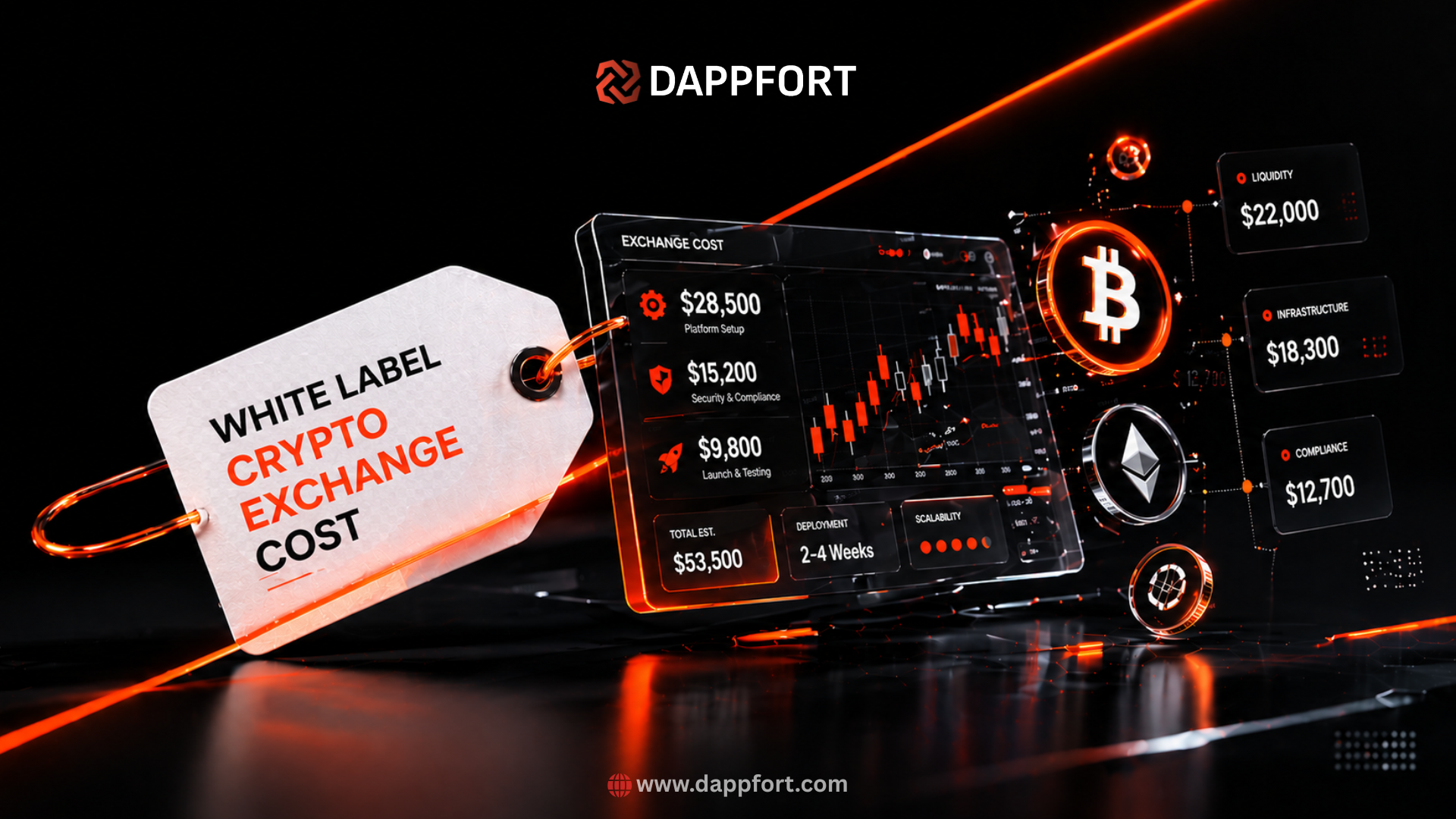
The white label crypto exchange cost in 2026 typically falls into three tiers based on the scale, features, and compliance requirements of your project:
Tier 1 — Basic Launch Package: $8,000 to $15,000
This is your MVP (Minimum Viable Product) setup. Great for startups testing the market.
What you get:
- Standard trading engine (spot trading)
- User registration and KYC onboarding
- Basic crypto wallet integration
- Admin panel
- A handful of trading pairs (BTC, ETH, USDT, etc.)
- Basic security features
What you do NOT get:
- Advanced order types (margin, futures)
- Multi-blockchain support
- Deep liquidity integrations
- Mobile apps
- Custom UI/UX design
Best for: Solo founders, small teams, or businesses testing the crypto exchange model before investing further.
Tier 2 — Advanced Feature Package: $15,000 to $50,000
This is the most popular tier for serious businesses entering the market.
What you get:
- High-performance matching engine
- Multi-currency and multi-blockchain support
- TradingView chart integration
- Advanced order types (limit, market, stop-loss)
- Liquidity aggregation from external providers
- Mobile app (iOS + Android)
- Custom UI/UX branding
- Enhanced KYC/AML module
- API access for institutional traders
Best for: Fintech startups, investment firms, or businesses that want a fully market-ready exchange with strong UX from day one.
Tier 3 — Enterprise-Grade Platform: $50,000 to $250,000+
This is the full-scale, institutional-grade setup for high-volume operations.
What you get:
- Ultra-low latency matching engine (handles millions of orders per second)
- Derivatives trading (futures, options, perpetuals)
- Staking and yield products
- Multi-jurisdiction compliance (FinCEN, MiCA, MAS, etc.)
- Custom trading bots and algorithmic tools
- White-glove onboarding support
- Dedicated infrastructure and SLA guarantees
- Deep analytics and risk management dashboards
Best for: Institutional exchange operators, banks entering crypto, or businesses targeting professional and high-net-worth users.
White Label Crypto Exchange Cost Breakdown
| Component | Basic | Advanced | Enterprise |
| Trading Engine | ✅ Included | ✅ High-performance | ✅ Ultra-low latency |
| Wallet Integration | ✅ Basic | ✅ Multi-chain | ✅ Institutional-grade |
| KYC / AML | ✅ Basic | ✅ Advanced | ✅ Multi-jurisdiction |
| Mobile App | ❌ | ✅ iOS + Android | ✅ Custom native apps |
| Liquidity Integration | ❌ | ✅ External providers | ✅ Deep multi-source |
| Derivatives Trading | ❌ | ❌ | ✅ Futures, options |
| Custom UI/UX | Limited | ✅ Full branding | ✅ Fully custom |
| Launch Timeline | 1–2 weeks | 2–6 weeks | 6–16 weeks |
Key Factors That Influence White Label Crypto Exchange Cost
Even within each tier, the white label crypto exchange cost varies significantly. Here is what moves the needle:
1. Security Features
Security is non-negotiable. In 2025, crypto hacks and exploits resulted in billions of dollars lost globally. A solid white label platform includes SSL encryption, two-factor authentication, multi-signature wallets, DDoS mitigation, and cold storage architecture.
More security = higher cost. But skimping on security is far more expensive in the long run.
2. User Interface (UI) and User Experience (UX)
A generic, cookie-cutter design will hurt user retention. Custom UI/UX — tailored to your brand, colors, layout preferences, and user journey — adds to the price but dramatically improves trust and conversion.
Budget: $2,000–$15,000 extra for a truly custom design.
3. Number of Features and Trading Modules
Every module you add — margin trading, staking, copy trading, referral systems, launchpad — increases cost. The more features, the more development, testing, and QA work required.
Start lean. Add features as you grow.
4. Multi-Currency and Blockchain Support
Supporting only Bitcoin and Ethereum is straightforward. Supporting 50+ tokens across multiple blockchains (Solana, BSC, Polygon, Tron, etc.) requires deeper integration, regular audits, and ongoing maintenance — all of which raise costs.
5. Regulatory Compliance (Especially for USA)
This is the most underestimated cost factor, particularly for US-based exchanges.
In the United States, you may need:
- FinCEN registration as a Money Services Business (MSB) — filing fees + legal costs: $2,000–$10,000
- State-level Money Transmitter Licenses (MTL) — varies by state, can range from $1,000 to $100,000+ per state
- BitLicense (if operating in New York) — application can cost $30,000–$100,000 in legal fees alone
No vendor can include these government fees in their platform cost. Always budget separately for compliance.
6. Liquidity Integration
An exchange without liquidity is an empty restaurant. Nobody stays.
Options:
- Build your own order book — takes time, requires market-maker relationships
- Integrate external liquidity providers — B2BX, Openware, etc.
- White label liquidity solutions — convenient but adds $500–$3,000/month in fees
7. Hosting and Infrastructure
Your exchange needs to be fast, reliable, and always online. Options:
- Cloud hosting (AWS, GCP, Azure): $500–$5,000/month depending on traffic
- Dedicated servers: $1,000–$10,000/month for high-frequency setups
- CDN and load balancing: Additional $200–$1,500/month
8. Ongoing Maintenance
After launch, you will need bug fixes, security patches, feature updates, and technical support. Budget 15–20% of your initial development cost per year for maintenance.
How Long Does It Take to Launch?
Time to launch depends on how much customization you need:
| Setup Type | Timeline | What’s Involved |
| Quick Launch | 7–14 days | Basic branding, standard trading pairs, minimal config |
| Moderate Customization | 2–4 weeks | Custom UI, additional features, basic compliance setup |
| Advanced Features | 4–8 weeks | Margin trading, staking, API integrations, mobile apps |
| Full Compliance + Customization | 8–20 weeks | Multi-jurisdiction licensing, enterprise infrastructure, custom modules |
Speed costs money. Full compliance takes time. Balance both based on your market and target users.
USA vs. Global — What Is the Difference in White Label Crypto Exchange Cost?
This matters more than most guides admit.
Launching in the USA
The US is the world’s largest crypto market — but also the most regulated. Additional costs include:
- State-by-state Money Transmitter Licenses (you may need 40+ licenses for full US coverage)
- FinCEN MSB registration
- IRS tax reporting compliance (1099-DA forms from 2025)
- Higher legal fees due to complex regulatory landscape
Extra budget needed for US compliance: $50,000–$200,000 depending on target states
Launching Globally (Non-US)
More flexibility, faster to market, but you still need to address:
- GDPR (Europe) — data privacy compliance
- MiCA regulation (EU) — crypto asset framework
- MAS (Singapore) licensing
- FCA registration (UK)
Extra budget for international compliance: $10,000–$80,000 depending on markets
White Label Crypto Exchange Cost — ROI Perspective
Here is the exciting part: how quickly can you make your money back?
A white label exchange generates revenue through:
- Trading fees (0.1%–0.5% per trade)
- Listing fees (charging projects to list their token: $5,000–$100,000)
- Withdrawal fees (flat fee per withdrawal)
- Staking and yield programs (spread between user rewards and actual yield)
- Referral and affiliate programs (user acquisition at scale)
A mid-sized exchange with 500 daily active traders doing $500,000 in daily volume at 0.2% fee earns $1,000/day or ~$30,000/month in trading fees alone.
Break-even on a $30,000 investment: as fast as 1 month if you acquire users quickly.
What to Look for in a White Label Exchange Provider
Before you compare any white label crypto exchange price, make sure the provider checks these boxes. If you are looking to start your own crypto exchange, partnering with an best cryptocurrency exchange development company can play a major role in your success. Not all providers are equal. Here is your checklist:
✅ Proven track record — real clients, real deployments
✅ Source code ownership — you should own what you pay for
✅ Security audit history — ask for penetration test reports
✅ Compliance modules — KYC/AML built-in, not an afterthought
✅ Ongoing support — who do you call at 2am if the exchange goes down?
✅ Scalability — can it handle 100x your initial volume?
✅ Transparent pricing — no surprise fees after signing
✅ Customization flexibility — can you add features later?
✅ Liquidity options — do they help you get started with liquidity?
✅ Demo available — never buy what you cannot test first
Conclusion
In 2026, launching a white label crypto exchange is one of the smartest moves an entrepreneur can make in the digital asset space. The white label crypto exchange cost is lower than ever, the technology is more mature than ever, and the global crypto market — now valued in the trillions — has never been bigger.
But going in without a clear budget plan is where most founders go wrong.
Here is the simple summary:
- Starting out: Go with a basic MVP — fast to launch, low risk, enough to validate your market
- Serious market entry: Choose an advanced package with full branding, mobile apps, and liquidity integration
- Enterprise-grade operations: Invest in institutional infrastructure — latency, derivatives, and deep compliance
- USA compliance: Always budget separately for state licensing — it is not included in any platform price
- Ongoing costs: Maintenance, hosting, KYC subscriptions, and support are monthly commitments — plan for them upfront
The right white label partner does not just hand you software — they help you build a business.
At Dappfort, we build white label crypto exchange platforms that are fast, secure, compliant, and built to scale. Whether you are launching your first exchange or upgrading an existing one, we are here to help you every step of the way — from your first line of branding to your first million in trading volume.
Ready to launch? Let’s build your exchange together.
FAQ
What is the average white label crypto exchange cost in 2026?
The average cost ranges from $8,000 for a basic MVP to $250,000+ for an enterprise-grade platform. Most serious startups fall in the $15,000–$50,000 range for a fully branded, market-ready exchange.
Is a white label crypto exchange cheaper than building from scratch?
Yes. Building from scratch can cost $25,000 to $80,000+ and take 12–24 months. A white label solution can launch in 2–8 weeks at a fraction of that cost.
How much does it cost to launch a white label crypto exchange in the USA?
The cost to launch a white label crypto exchange in the USA typically starts from $10,000 for a basic setup and can exceed $200,000 depending on features, infrastructure, and regulatory compliance requirements.
How long does it take to launch a white label crypto exchange?
Basic exchange: 7–14 days
Moderate customization: 2–4 weeks
Advanced setup: 4–8 weeks
Enterprise/compliance-heavy builds: 8–20 weeks
How do white label crypto exchanges make money?
Revenue typically comes from:
1. Trading fees
2. Token listing fees
3. Withdrawal fees
4. Staking spreads
5. Referral programs
For example, an exchange with $500,000 daily volume at a 0.2% fee could generate around $30,000 per month.